

Women Don’t Fail Therapy. Therapy Tools Fail Women.
Dilation therapy works — when women can stay with it. But the tools that have traditionally been used to deliver that therapy were not designed with adherence in mind. They were designed to dilate. Milli was designed to do something different: to make dilation therapy feel manageable enough to return to, session after session.
Why that matters:
In either a dilator-only or a Pelvic PT pathway, home therapy adherence is what determines outcomes. If adherence is low, so is the success rate. A tool engineered to reduce friction — not just physically, but emotionally — makes consistency more achievable.
Key principle:
Milli exists to reduce physical and emotional stress — so dilation therapy becomes more manageable, structured, and achievable.
The Adherence Gap
Traditional approaches to pelvic muscle tightness show meaningful gaps in real-world follow-through.
85%
of Milli users stayed on track at 6 months
41%
of static dilator users discontinue by 3 months
29%
of Pelvic PT referrals complete the full treatment course
25%
static-dilator adherence reported at 12 months
Discontinuation is often attributed to discomfort, reinsertion friction, and emotional distress — all factors that Milli’s design was built specifically to reduce.

Engineered to Match Your Anatomy
The vagina is naturally flexible. At rest, its walls gently touch; during penetration, it is designed to expand. The resting vagina is “H”-shaped, and its dimensions change as it expands — from roughly 17mm at the opening to around 45mm at the back.
Milli’s 15–40mm expansion range was chosen to sit precisely inside that natural anatomy. It starts at 15mm — approximately the width of a tampon — and expands in 1mm increments up to 40mm, which is close to the average erect penis width of 37mm.
Why the anatomy match matters:
- Progression never exceeds what the body is designed to accommodate
- The smallest starting size is reassuringly familiar (comparable to a tampon)
- The largest size builds confidence for intercourse without pushing past natural limits
- The range covers the full desensitization arc in a single device
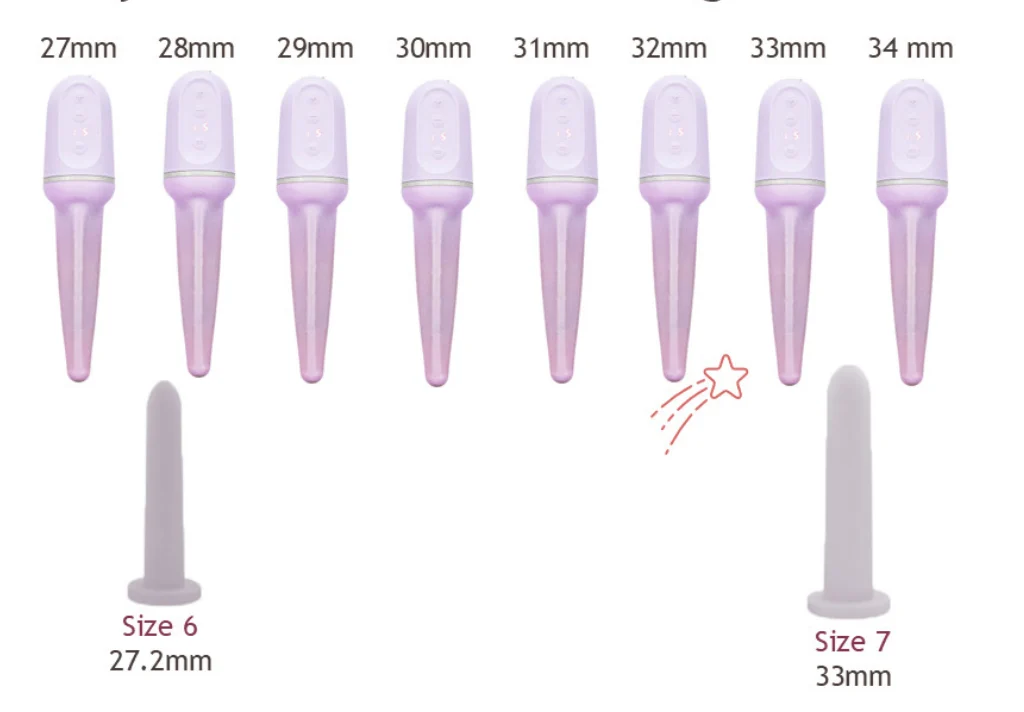
The Power of One Millimeter
Traditional dilator sets require a physical jump to a larger device to progress. That jump — sometimes 5mm or more between static sizes — is a moment of disruption: removal, reinsertion, and a visibly larger tool to face. Research links those jumps directly to high discontinuation rates.
Milli expands one millimeter at a time, with no removal or reinsertion required between sizes. That subtle shift removes the size-jump threshold that may cause women to stop.
What 1mm precision enables:
- Progression you can feel, not fear
- No visible size confrontation between sessions
- Real-time digital display for measurable progress
- A starting point and an ending point in the same device
- Control returned to the user, one millimeter at a time
The Science of Integrated Vibration
Muscle guarding and anxiety are two of the biggest barriers to dilation progression. Vibration is a well-studied complement to dilation therapy because it addresses both — physically relaxing tight pelvic muscles and reducing the body’s pain response.
How vibration supports dilation therapy:
- Improves blood flow to the area, helping tight muscles soften
- Desensitizes the pain response, so sessions feel less intense
- Combines two therapies in one device — no separate vibration tool needed
What the clinical data shows:
- 80% of Milli users used the vibration feature at least half the time
- 57% reported reduced anxiety related to sex after 3 months
- 85% made meaningful progress toward intercourse after 3 months
Why it’s integrated, not separate:
When vibration is built in and easy to access, people use it. Integrating it into the device — instead of requiring a second tool — removes one more barrier to consistent therapy.

Clinical Outcomes
Engineering only matters if it produces measurable results.
85%
made meaningful progress toward intercourse within 90 days
68%
reported intercourse was more comfortable after 3 months
97%
agreed Milli was easy to use at 6 months
80%
would recommend Milli at 6 months
Static vs. Expanding Dilators: The Design Differences
A factual comparison of how each tool works — not a judgment. Both can be useful; the one that supports consistent use is the one most likely to help you reach your goals.
| Design Feature | Static Dilator Sets | Milli Expanding Dilator |
|---|---|---|
| Sizing | Multiple fixed sizes (typically 5–7 devices) |
One device, 15–40mm continuous range
|
| Size adjustment | Requires removal and reinsertion of a larger device |
Adjustable in 1mm increments, no reinsertion
|
| Size increments | Jumps up to 5mm between sizes |
1mm precision
|
| Vibration | None integrated (separate device required) |
Optional low and high integrated vibration
|
| Progress tracking | Visual/manual estimate |
Real-time digital display
|
| Storage | Multiple devices |
Single device with discreet charging case
|
| Prescription | Varies |
FDA-cleared over the counter
|
| Published data | 41% discontinue by 3 months, 57% by 6 months | >85% on-track at 6 months (Milli clinical study) |
Go Deeper
For more on the science and design choices behind Milli, explore our long-form articles.